

LETTERS FROM THE FRONTLINE: When Art Refuses to Be Silent
Some projects arrive at exactly the right moment. This one did.
When Irina Petrik and Evan Mack reached out and asked if I would create the cover illustration for Letters from the Frontline, I loved the idea immediately — not just as a design brief, but as a form. Something that began as a poem, written by a soldier on the front line, had traveled into music, and now needed a visual world to inhabit. Three art forms, one truth. I wanted to be part of that chain.
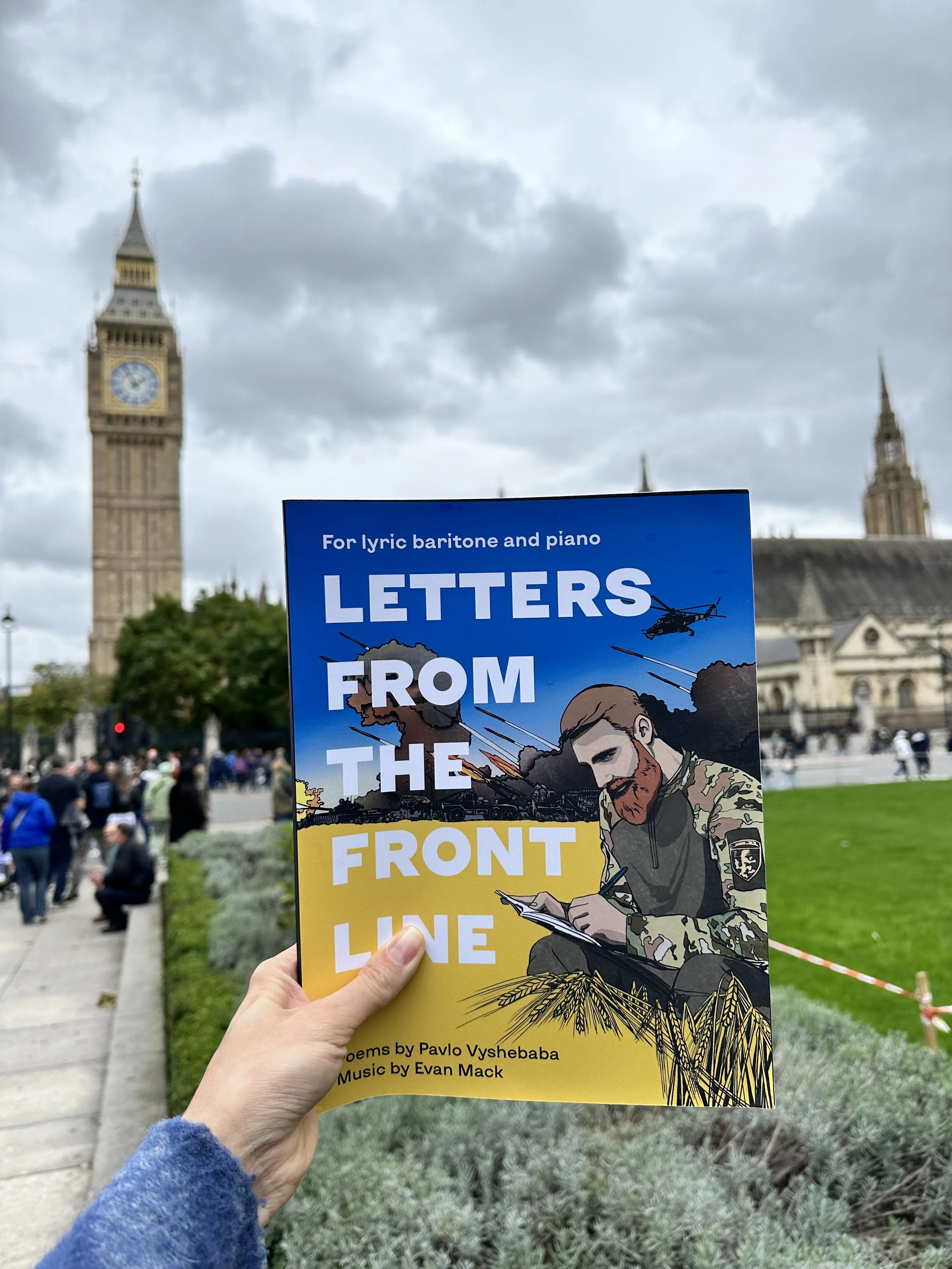
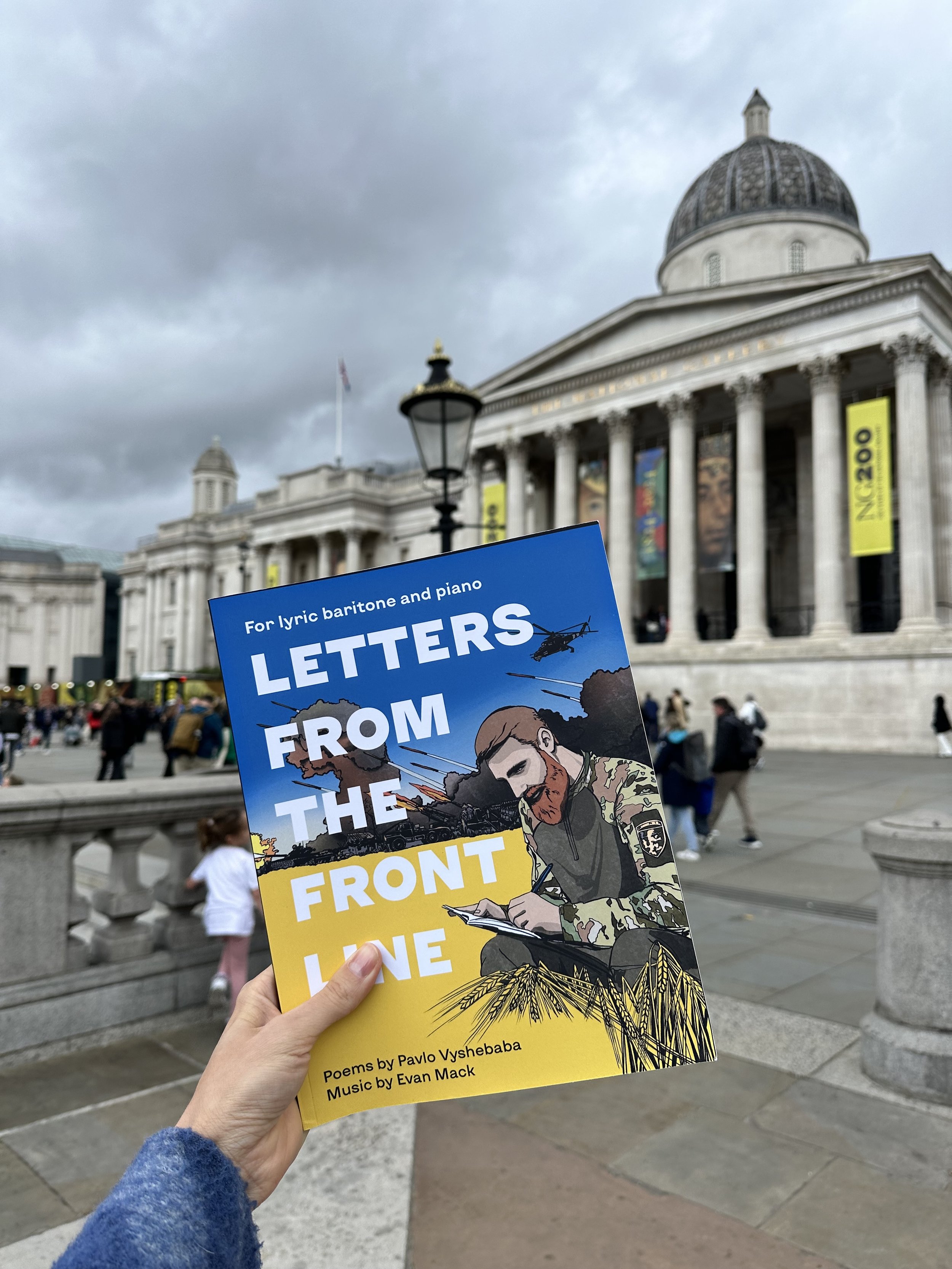
London, 2024 — holding the book near Big Ben, not yet knowing I'd be writing about it from the other side of the world.
Pavlo Vyshebaba is a Ukrainian poet. He's also a soldier, defending Ukraine on the front line. The poems in Letters from the Frontline are addressed to specific people — his mother, his daughter, his wife, a fellow soldier, a priest. Each one is a letter. Each one was written inside the ongoing, not after. One line has stayed with me since I first read it:
"When all the machine guns become silent, and we will finally hear the spring, with what thirst we will make love to wash away the war from our skin."
That's not a war poem. That's a love poem written in a war. The difference matters enormously.
When American composer Evan Mack set these poems to music, the cycle traveled. The world premiere took place in February 2024 at Salle Bourgie in Montreal — performed in original Ukrainian by Mariupol-born baritone Ihor Mostovoi and pianist Serhiy Salov. People in the audience were crying. Music asks you to feel what you might otherwise only observe.
When I sat down to make the cover, I spent a long time with one question: what does this image actually need to be?
Here's what I made, and why.
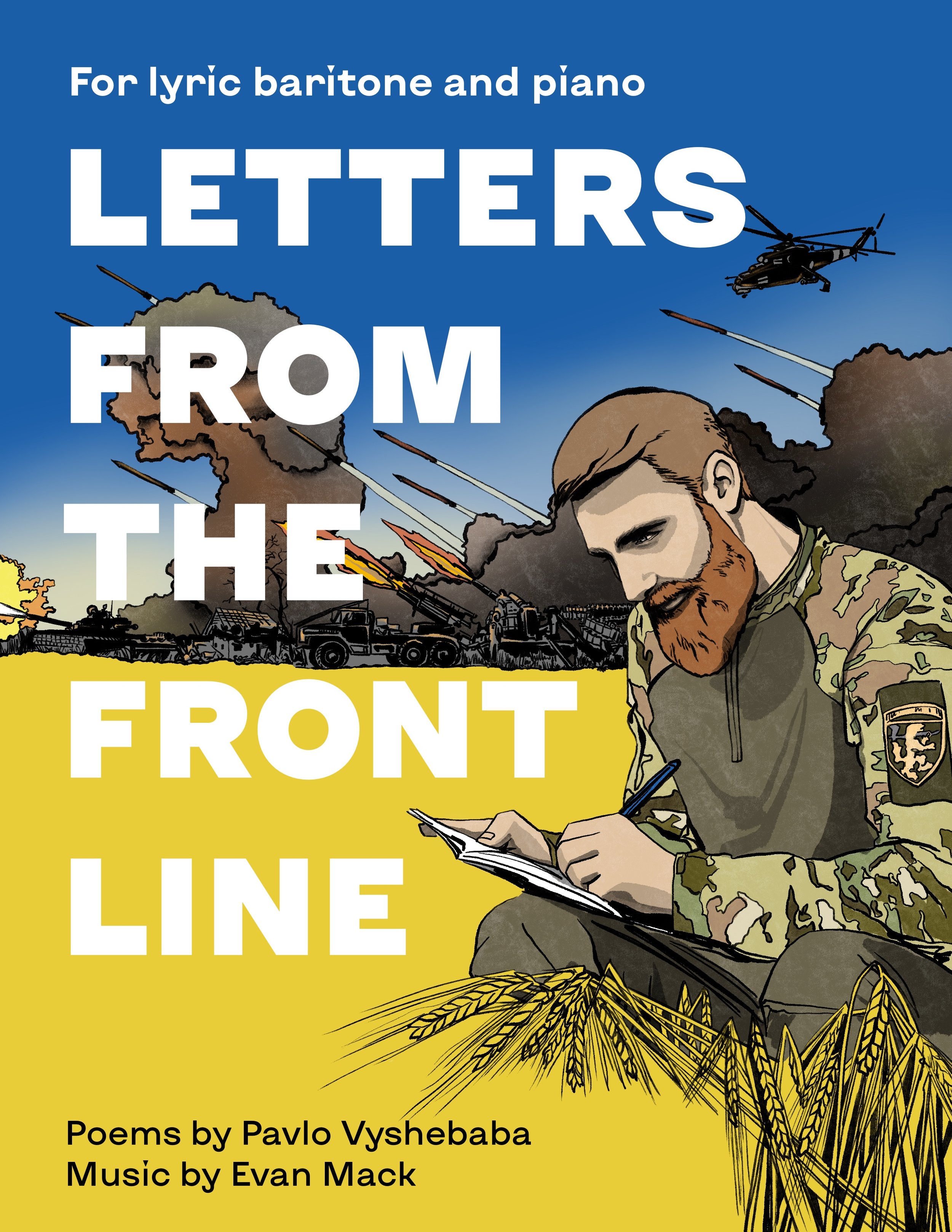
Book cover
Pavlo sits in a field of wheat — golden, full, present. He's writing. Above him, blue sky. He is literally held inside the colors of Ukraine: yellow below, blue above, his figure the living thing between them. Not as a design decision. As a true thing.
And then, in that band of space between the yellow and the blue — on the horizon, at the edge of the world — war. Missiles cutting through the air. Black smoke rolling. A helicopter. Fire. A hint of sunrise behind it all — not decoration, but hope. The insistence that morning still comes.
Close: a man writing a letter. Far: the machinery of destruction in motion. Around them: the colors of the country he is writing from and writing for.
That distance is everything. The war is not a memory here — it is ongoing, advancing, present. But it has not reached him yet. And in that space, he writes. He reaches toward someone he loves. He makes language.
That is not sentiment. That is the most radical act I can imagine.
I grew up near the Azov Sea. I spent my childhood and teenage years in Berdiansk — a port city on its shore — learned to draw there in the studio of a local artist, finished school and art school there, became an artist there. That city is now under Russian occupation. So is the native city of Ihor.
I don't say this to make myself part of the story. I say it because it changed what I saw when I looked at this project. It changed what felt honest and what felt like a shortcut. The wheat in this image is not a symbol I chose from a distance. It's something I know. The blue sky above the field is not borrowed. When I drew Pavlo sitting in that field, I was drawing from something I carry.
Ihor Mostovoi, who performed the premiere, is from Mariupol. He watched from sixty kilometers away as his city was destroyed. That experience lives in how he sings these poems — not as information but as bone-deep knowledge. Evan Mack, who wrote the music from America, understood something rare: that empathy isn't passive. He reached out to Ihor in the very first days of the war, wanting to do something. The music came from that impulse.
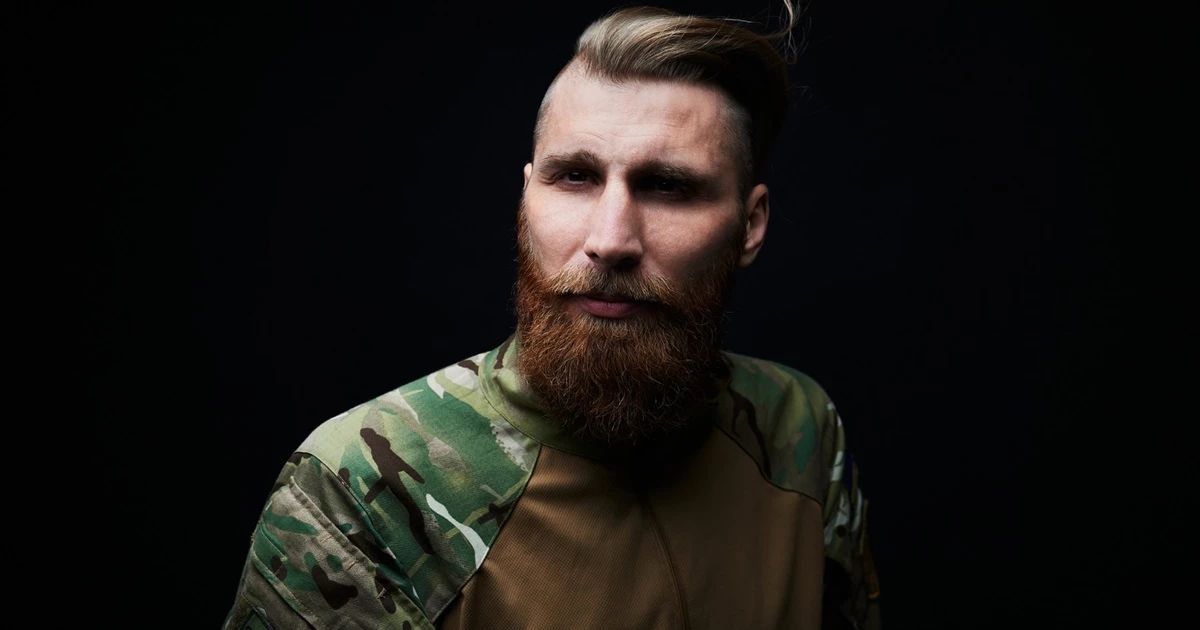
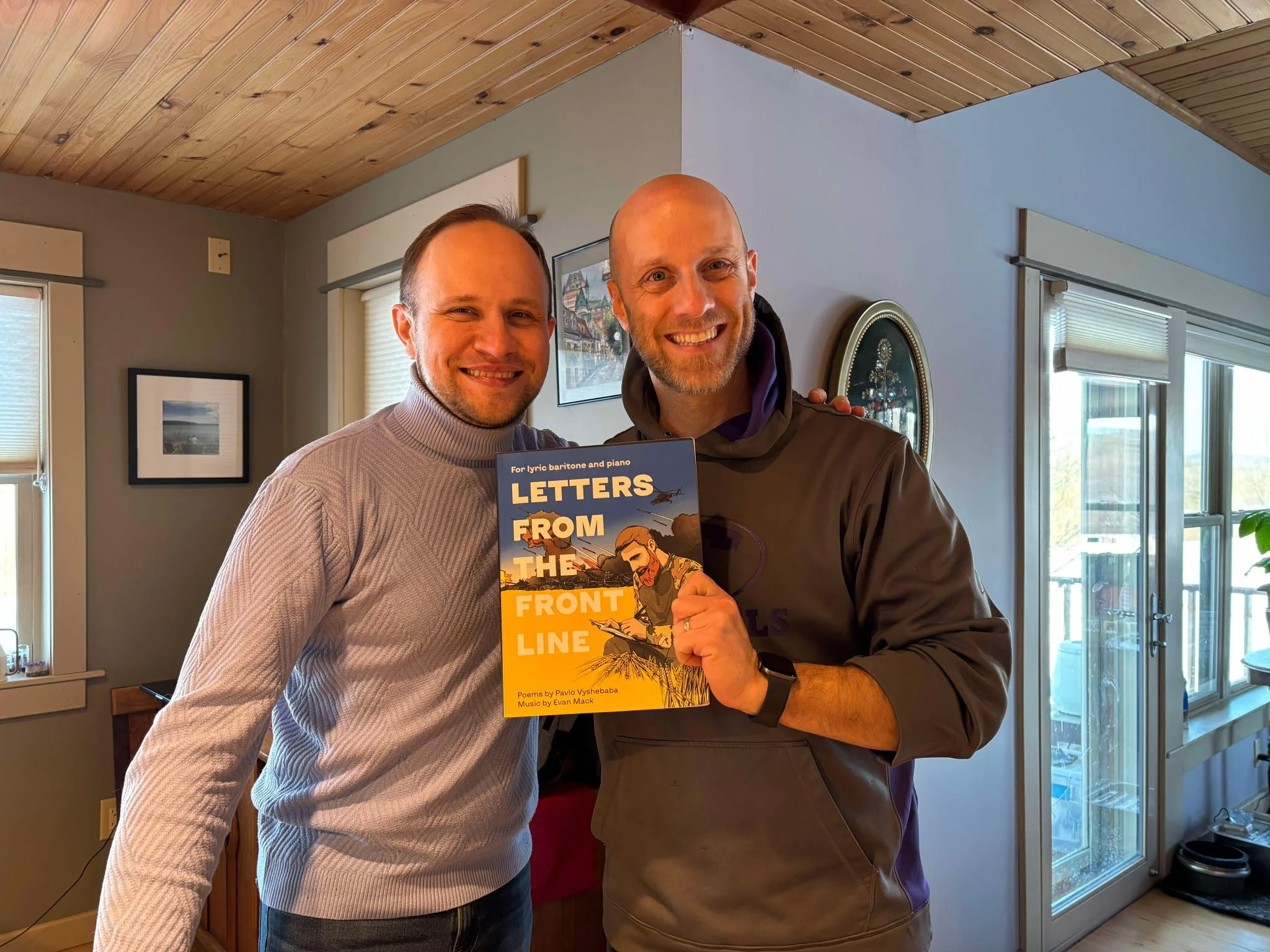
All of us brought our piece from different corners of the world — Evan and Irina from New York, Ihor from Paris, and me from London (where I was at that time) — toward one shared purpose.
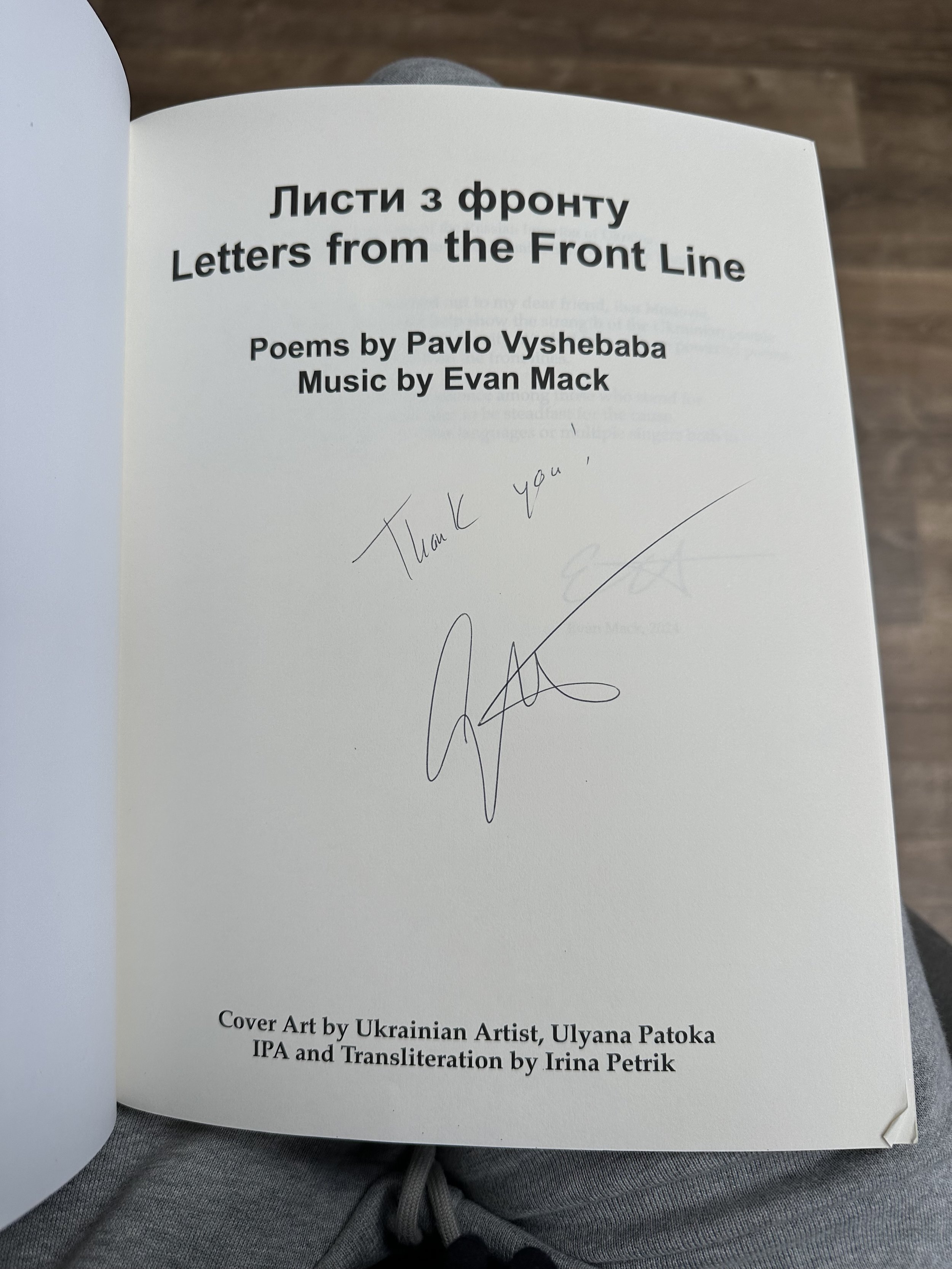
The project grew through real collaboration. UCVP founder Irina Petrik developed phonetic transliteration and pronunciation guides so the music can be sung by non-native speakers — so Pavlo's words can travel into voices that don't share his language but want to carry something of his truth. My own illustration grew through conversation too: drafts, feedback, the decision to add colors.
Every choice was in service of the same thing: the person comes first. Not the conflict. Not the symbol. The person.
I've thought a lot about what illustration is for, when something real is happening.
It's not to explain. It's not to make suffering easier to look at by making it beautiful. I think it's to hold one thing steady and say: I was paying attention. This mattered. I tried to see it clearly and not look away.
Pavlo keeps writing. That's not a metaphor — that's the fact the entire cover is built around. In the middle of an unfolding catastrophe, he finds a moment for language, for tenderness, for love. The letter becomes a small, luminous act of resistance. Life insisting on itself.
A soldier is still someone's beloved. A letter is still a lifeline. Art is still survival.
Слава Україні.
Letters from the Frontline — poetry by Pavlo Vyshebaba, music by Evan Mack, performed by Ihor Mostovoi, IPA diction resources, phonetic transliteration and pronunciation guides by Irina Petrik, cover illustration by Ula Patoka. The score is available here.