

The Pipeline of Cultural Erasure (and How It Turns into Theft)
Where Cultural Erasure Starts
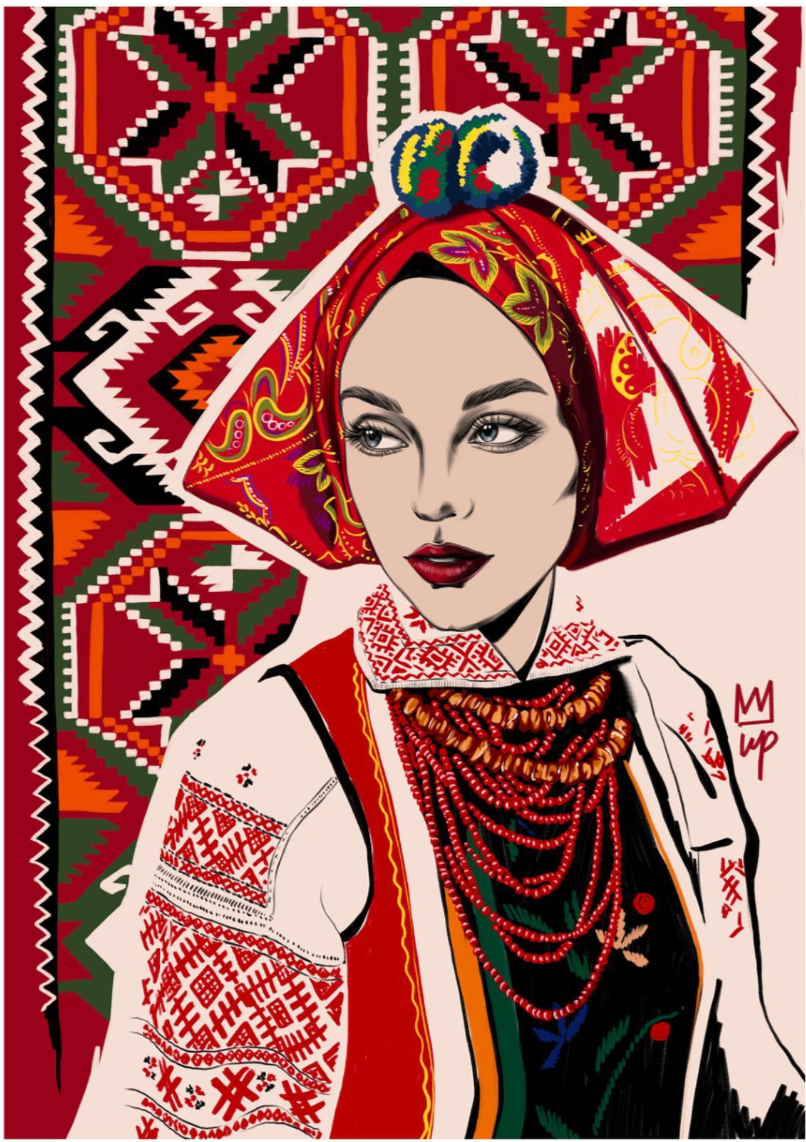
I did a simple thing today: I dropped one of my artworks into Google image search to see if it’s being used anywhere it shouldn’t be.
What came back was… a perfect snapshot of how cultural erasure happens online, and how it can turn into commercial theft.
My artwork is titled “Ukrainian Woman Portrait.” Context: this was one of my first illustrations of a Ukrainian traditional costume back in March 2022, created for non-commercial, educational purposes (shortlisted in the 5th FIDA Awards). And 3–4 years later it’s still reaching people’s hearts. Why? Because there was great work behind the reference photo (2015) I used—shout-out to photographer Valerii Neduta, the gorgeous model Valeria Kosherieva, and the Vytoky project by the Ukrainian Institute of Fashion History (UIFH). Later, I registered the artwork’s copyright.
And yet in search results and Pinterest saves, it’s been re-filed under everything except what it is:
“Romania ideas”
“Russian folk art”
“Bulgarian inspiration”
“Traditional Azerbaijan art”
“Polish posters”
“Eastern European”
“Khokhloma”
“Turkish style”
“Muslim coloring pages”
“Moldavian art”
generic “cute art”
random boards with no credit, no context, no origin — just “folk”
And here’s the part that hits hard: I genuinely love that people feel something and want to save it. I don’t love that in the process, my name disappears — and UKRAINE disappears too.
The System That Turns Art into “Orphan Content”
To be fair, folk traditions across Eastern Europe, the Balkans, and parts of the Caucasus do share visual “grammar”: geometric embroidery, red/white/black palettes, woven kilim-style patterns, headscarves, layered beads. If someone doesn’t know the regional details, it’s easy to lump everything into a vague “folk” bucket.
But the bigger issue is structural. Pinterest and visual-search tools sort by similarity and keywords, not cultural accuracy. Users label saves for discoverability (“Romania ideas,” “Turkish style,” “Eastern European”) rather than TRUTH. Once one person mis-tags an image, that label gets copied through repins, and common biases (“anything Slavic is Russian,” or “headscarf = Muslim”) amplify the drift. Add the fact that these platforms strip context and make saving frictionless, and authorship gets detached fast, and in a minority of cases, that detachment is exploited intentionally to repost without credit or turn “anonymous folk aesthetic” into something commercial.
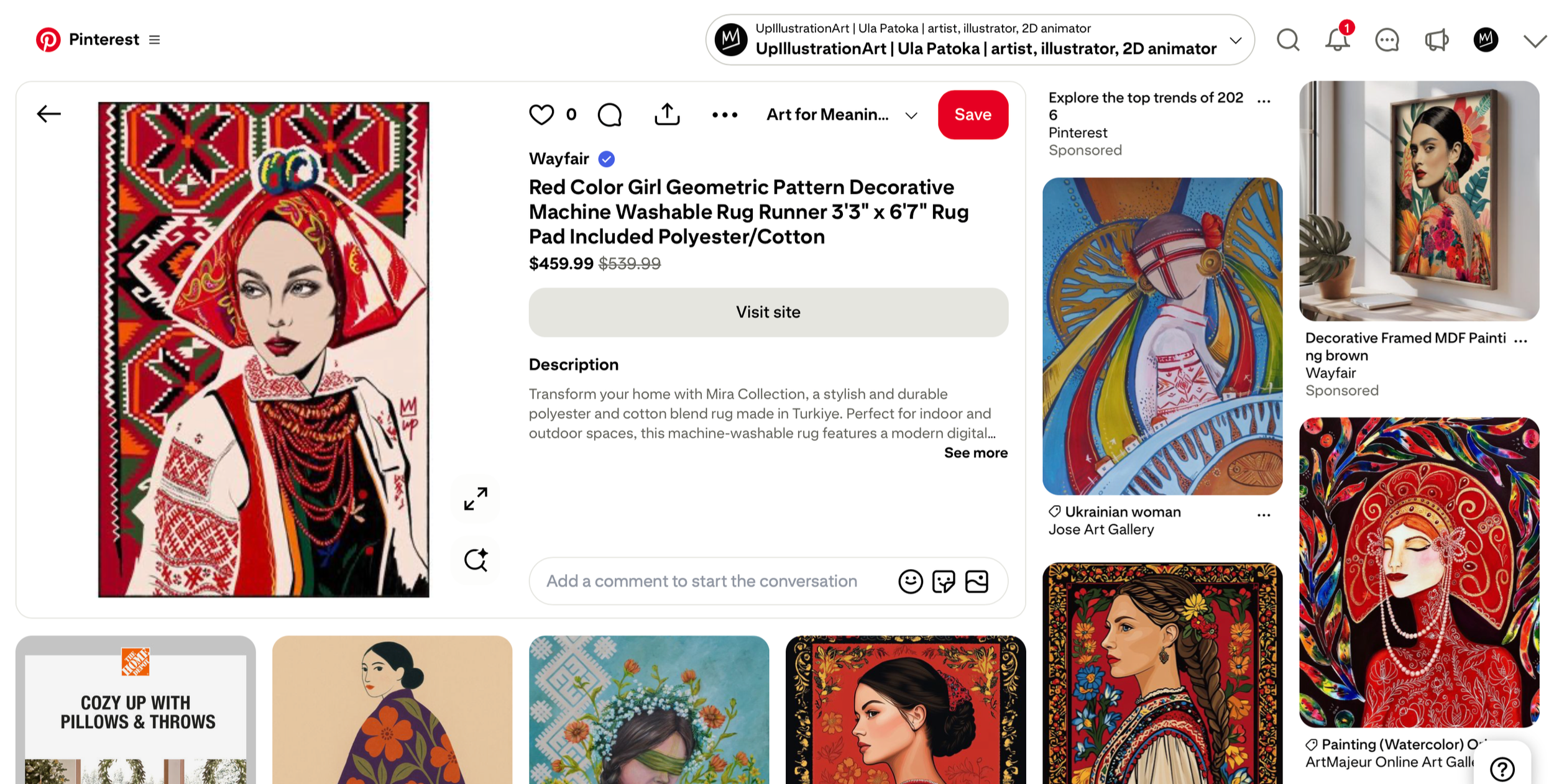
Wayfair Pinterest ad featuring my copyrighted artwork “Ukrainian Woman Portrait,” marketed as “Red Color Girl Geometric Pattern…” and linking to the Wayfair rug listing.
This is the theft funnel:
A piece gets saved without credit.
It gets re-tagged with whatever keyword performs.
It gets copied again and again until it becomes “anonymous folk aesthetic.”
And then, at some point, someone decides it’s free to monetize.
In my case, it already crossed that line.
From Mislabeling to a Wayfair Listing
My artwork was used without authorization and sold as a rug on Wayfair under the Hokku Designs label. I also saw my artwork used in digital ads/posts that pointed back to the Wayfair listing. That’s how I discovered the infringement in the first place. What makes this especially hard to ignore is that the listing used my artwork with my signature still visible. My authorship was on the image the entire time!
I’m currently handling this through counsel, and I have full documentation and screenshots.
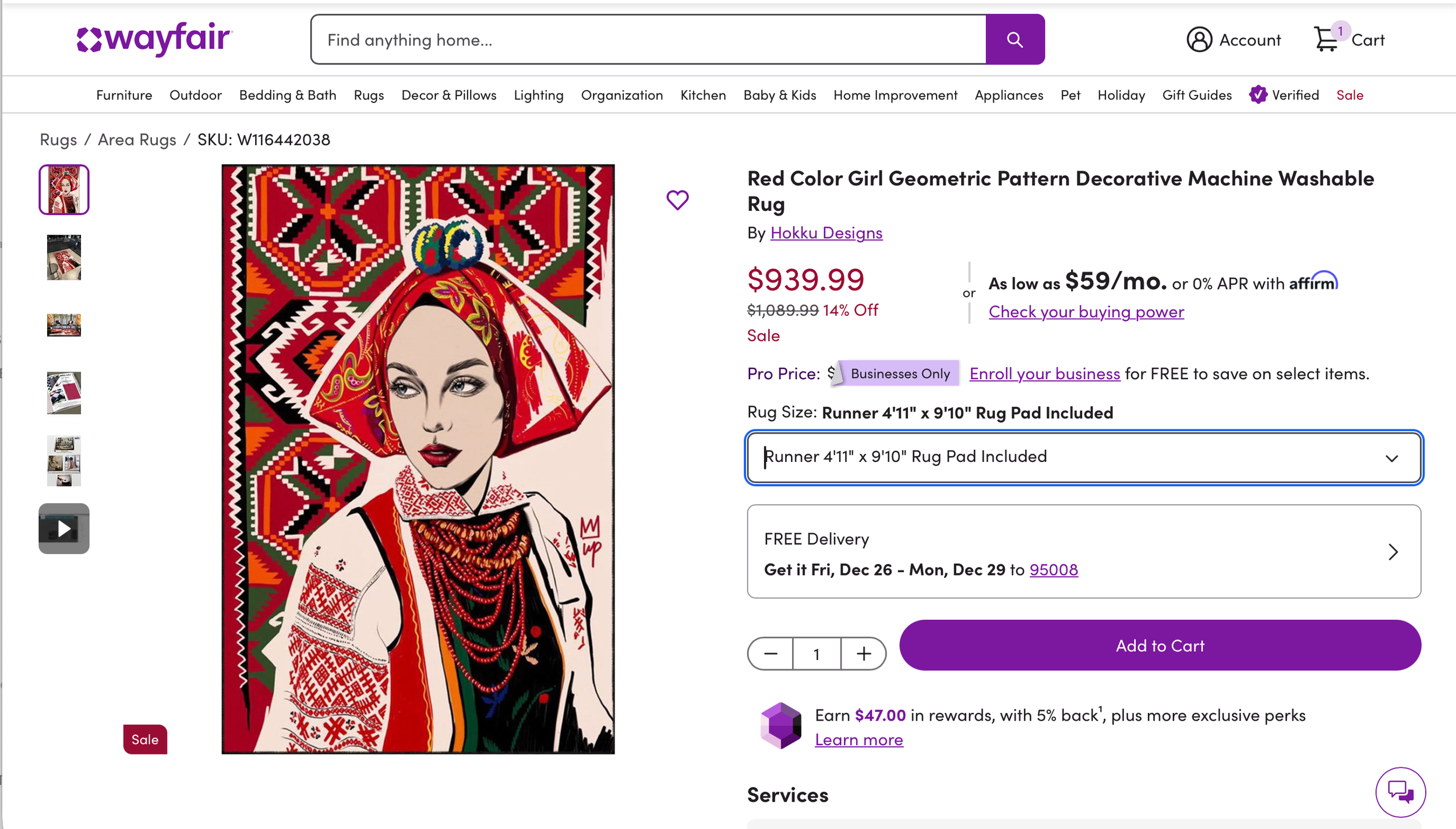
Wayfair product listing for a rug displaying my copyrighted artwork “Ukrainian Woman Portrait” (signature visible) under the “Hokku Designs” label.
Mislabeling is the mechanism that turns a clearly credited artwork into “orphan content”: the image spreads faster than the source, and my name, and Ukraine, fall away with every repin. And once a piece becomes orphan content, commercial infringement starts to feel low-risk, because to a reseller or supplier it looks like an anonymous, ownerless asset that’s “everywhere online,” and therefore fair game to monetize.
Mislabeling and context collapse might explain how an image gets detached from its source, but it does not excuse commercial use. Lazy tagging on Pinterest, vague boards like “folk,” or algorithmic misclassification are not permission, and they’re certainly not a shield for companies with legal teams and compliance processes. Once a corporation profits from an artwork, the standard is simple: do basic due diligence, trace the source, and license it. When your signature is still on the work, the “we didn’t know” narrative is even harder to take seriously.
I’m sharing this for two reasons. First, if you save art on Pinterest (I do too), please keep the author attached — a name, a link, the original source. It’s not “ego.” It’s basic respect, and it’s often the only thing preventing a credited artwork from turning into orphan content that can be repackaged and sold. Second, for fellow artists: build simple habits that re-attach authorship and protect your work: create one canonical source page on your site, pin your own originals back to it, add subtle watermark/metadata where it makes sense, and run routine reverse-image searches.
If you love a piece, share it with credit and a link. If you want to use it commercially, license it.
Culture is not a free texture pack.